

In 2026, the UAE business environment has become more transparent, digitally regulated and well structured. Ranging from corporate tax enforcement, AML monitoring and e-invoicing systems, businesses are required to maintain strong compliance standards in adapting global regulatory practice.
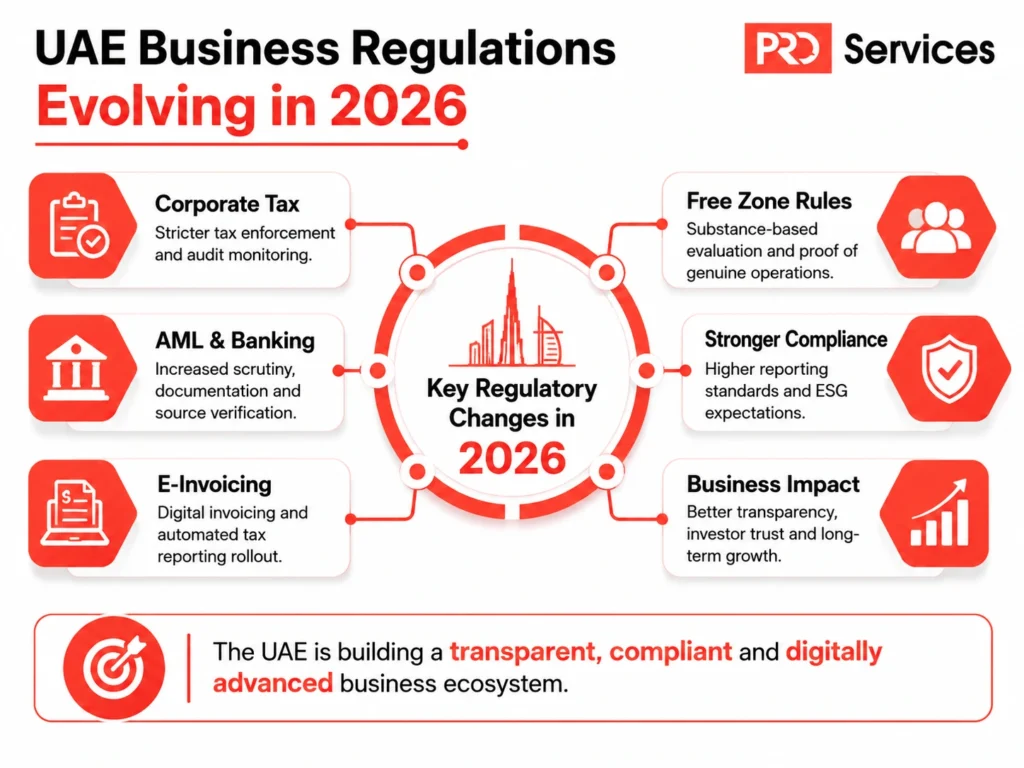
Policy direction
Key UAE regulatory changes business impact area in 2026 are as follows:
| Area | Regulatory Direction | Business impact |
| Corporate tax | Stronger tax monitoring. | Higher compliance responsibility. |
| AML rules | Increased banking scrutiny. | More documentation required. |
| E-invoicing | Digital tax system rollout | Automated reporting system. |
| Free zone rules | Substance based evaluation. | Operational proof required. |
| ESG & Governance | Transparency expectations. | Enhanced reporting standards. |
Major policy changes
- UAE alignment with OECD global standards.
- Emphasize on financial transparency.
- Mandatory digital compliance.
- Investor protection system.
- Freezone entity accountability.
Enforcement tightening
Areas of higher scrutiny
- Corporate tax compliance
It is necessary for UAE businesses to:
- Maintain accounting record accuracy.
- Tax return submission.
- Deduction and exemption justification.
- Maintenance of audit ready documentation.
- AML and banking checks
Onboarding process tightening by banks through:
- Funding source verification.
- UBO disclosure.
- Transaction monitoring.
- Compliance background check.
- Free Zone substance requirements
UAE authorities are checking:
- Presence of physical office.
- UAE employee activity.
- Operational expense in UAE.
- Genuine commercial operations.
- VAT and E-invoicing
Businesses are preparing for:
- Automated VAT reporting.
- Digital invoicing system.
- Real time tax monitoring.
- Minimal manual compliance procedure.
This reading might have reminded you of UAE business setup services – Check our service support!
Quick Business Implication
| Business type | Expected impact |
| SMEs | Higher compliance awareness requirement. |
| Free zone companies | Necessity of operational substances. |
| Startups | Enhanced accounting system required |
| Global firms | Powerful reporting obligations. |
| Trading businesses | Enhanced AML monitoring. |
Also read aboutUAE Corporate Tax Compliance in 2026!
Conclusion
UAE is growing in terms of an international trusted business ecosystem but with strict and structured regulations. Businesses emphasizing on transparency, compliance and digital readiness can enhance investor confidence, operational stability and banking access in the long run.
If you are also concerned about UAE regulatory changes business impact then connect with us and our professional consultant team will let you evolve with UAE business regulations 2026.
Frequently Asked Questions (FAQs)
What is the biggest UAE regulatory changes in 2026?
Biggest UAE regulatory changes in 2026 consist of e-invoicing preparation, corporate tax enforcement, AML monitoring and strict freezone compliance.
Are free zone companies still tax free in UAE 2026?
Free zone companies, especially qualifying businesses that meet operational substance rules, can maintain tax benefits.
Why is banking becoming stricter in the UAE?
UAE banks are increasingly maintaining transparency and AML checks for the alignment of global financial standards.
What is e-invoicing for UAE businesses?
E-invoicing is one digital invoicing feature developed for automated tax reporting and enhancement through transparency.
Which UAE businesses are most affected due to evolving regulations in 2026?
Startups, consultancy, trading companies, international structures and financial services are highly impacted UAE businesses due to evolving regulations in 2026.



No comment yet, add your voice below!