

UAE private sector wage rule and compliance has become highly sensitive for UAE employers since update of Wage Protection System (WPS) framework that clearly introduced payment timelines and progressive measures in regards to the delayed wages.
Discover through this guide regarding UAE private sector wage rule comprising 85% payment requirement, complaints, exclusion and employer penalties.
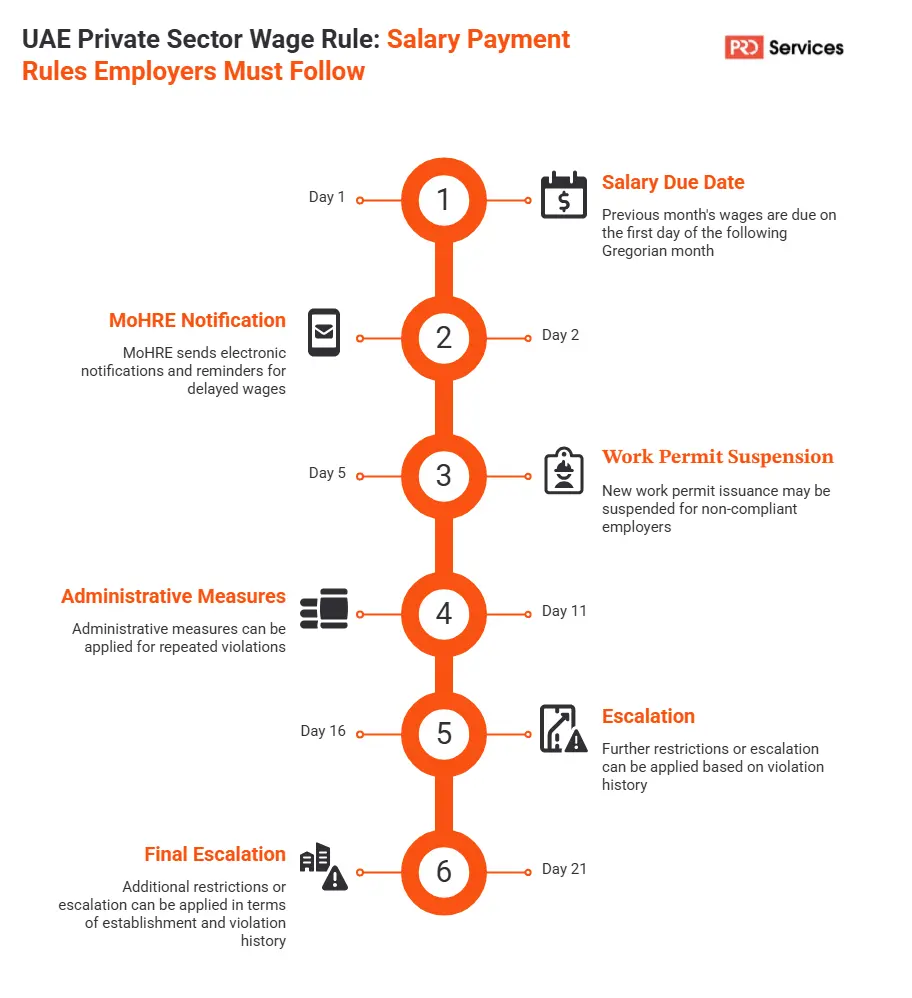
UAE private sector wage rule framework
It has been made clear in the UAE that the payment must be done on time.
- Federal Decree Law No. 33 of 2021 needs employers to deliver payment on their due dates under ministry approved rules.
- Employment contracts need to clearly specify the amount and type of the wage.
- Payment is usually made in UAE dirhams unless other currencies get agreed on the contract.
- MoHRE registered establishments need to follow applicable WPS requirements.
Such a legal framework leads directly to 2026 WPS requirements.
WPS under Ministerial Resolution No. 340 of 2026
The 2026 update makes the payment timeline more explicit.
- Ministerial Resolution No. 340 of 2026 concerning the Wage Protection System (WPS) is a current framework referenced by the UAE government.
- Previous month salary becoming due on the first day of the following Gregorian month.
- Employers require to transfer at least 85% of the total wages due on time where lawful deductions apply.
- MoHRE uses progressive monitoring measures when wages are delayed.
Acknowledging the deadline is important, but employers also need to know how payment must be processed.
Salary due date: first day of each Gregorian month for the previous month’s wages
A compliant salary process depends on both payment channel and timing.
| Requirement | 2026 position |
| Salary due date | First day of the following Gregorian month |
| WPS payment | Through approved WPS channels |
| Payment providers | Exchange house, banks or authorised financial institutions |
| Currency | AED or another agreed contractual currency |
| Monitoring | MoHRE electronic monitoring |
WPS permits MoHRE to monitor wage payments and employer compliance.
Current 85% wage-transfer requirement where lawful deductions apply
The threshold 2026 is very significant, however it does not cancel any entitlement of the employee to agreed wages.
- Establishment is treated as compliant where a minimum of 85% of total wages due are transferred within the prescribed time.
- With existing lawful deductions, the relevant deduction must be properly justified and documented.
- The 85% threshold is a WPS compliance measure and not a permission to withhold the remaining salary.
Therefore, with amount establishment, employers must apply an approved payment channel.
WPS payment channels
WPS is one electronic payment mechanism instead of a cash-based payroll process.
- UAE private sector wage rule enlists:
- UAE banks
- Authorised Financial institutions
- Exchange houses
- Authorised providers are required for wage payment services.
- Employers remain responsible for compliant salary payment even when a third-party processes payroll.
However, certain employees and employers can be excluded from WPS compliance.
Employee categories excluded from WPS
The 2026 resolution recognises specific employee circumstances.
- Employees whose wage complaint has been referred to the judiciary.
- Employees reported within a work abandonment report.
- Employees on documented unpaid leave.
- Employees are subjected to qualifying restrictions on their freedom.
- Certain seafarers.
- Certain foreign employees getting wages outside the UAE.
- Workers holding mission work permits for up to 3 months.
Employers’ status can also determine whether WPS applies.
Employer categories excluded from WPS
Certain employers also are particularly excluded from WPS compliance.
- UAE nationals owning fishing boats
- UAE nationals owning public taxis
- Banks and Financial institutions
- Houses of worship
Such exclusions are clearly identified in the present UAE government guidance.
Delayed/non-payment procedures under UAE private sector wage rule
One delayed salary can turn out to be a progressively serious compliance factor.
- By Day 2 to MoHRE electronic notifications and reminders will begin.
- By Day 5 New Work permit issuance may be suspended.
- By Day 11 administrative measures can be applied on qualifying repeated violation cases.
- By Day 16 and Day 21 additional restrictions or escalation can be applied in terms of establishment and violation history.
Employees also have a formal route when wages remain unpaid.
MoHRE salary complaints regarding UAE private sector wage rule
Under UAE private sector wage rule, the unpaid wages do not have to remain an unresolved employer-employee dispute.
- Employees can contact the Ministry of Human Resources and Emiratisation (MoHRE).
- One salary complaint can also be registered for delayed or unpaid wages.
- Supporting documents like contracts, payment records and payslips can help in establishing the claim.
For employers, unresolved wage problems can cause broader compliance consequences.
Penalties and compliance consequences under UAE private sector wage rule
WPS non-compliance can impact an establishment beyond the one payroll cycle.
- Work permit restrictions can be applied.
- Administrative penalties can be implied due to repeated violations.
- Establishment classification can be affected.
- Repeated or serious cases can cause labour disputes or further legal measures.
Entity coverage: MoHRE, WPS, UAE Labour Law
Three elements work together in case of UAE private sector wage rule and compliance.
| Entity/framework | Role |
| UAE Labour Law | Establish employer wage obligations |
| MoHRE | Administers and monitors employment compliance |
| WPS | Processes and monitors wage payments |
It is necessary for employers to review employment contracts, deductions, payroll records as well as WPS payment confirmation.
Conclusion
The UAE private sector wage rule currently places specific emphasis on timely WPS salary payment with wages due from the first day of the following Gregorian month and an 85% compliance threshold.
It is necessary for employers to review deductions, payroll procedures and WPS records timely.
Do you need support for UAE company and employment compliance?
Connect with ProServicesDubai for PRO support and legal execution.
Frequently Asked Questions (FAQs)
When is the salary due under 2026 UAE private sector wage rule?
Salary regarding the previous month is due on the first day of the following Gregorian month.
What is the 85% WPS rule?
85% WPS rule stands for 85% of total wages due must be transferred within the prescribed period of WPS compliance.
Can one employee complain about a delayed salary?
Definitely, UAE employees can contact or register a salary complaint on MoHRE.
Who is excluded from UAE private sector wage rule?
Certain employees and employers comprising unpaid-leave employees, banks, house of worship and certain seafarers are excluded from WPS rules.
What happens after delayed salary payment?
MoHRE can start applying progressive notifications, work permit restrictions and further administrative legal measures depending on the circumstances.



No comment yet, add your voice below!