

WPS employer obligations in the UAE have changed significantly in 2026 as UAE employers need to manage monthly payroll. It now requires attention to the first-day of the month salary deadline, 85% compliance threshold and phased enforcement under Ministerial Resolution No. 340 of 2026 effective from 1st June 2026.
Understand WPS employer obligations in the UAE comprising 2026 salary deadlines, deductions, 85% transfer rules, exemptions, complaints and penalties.
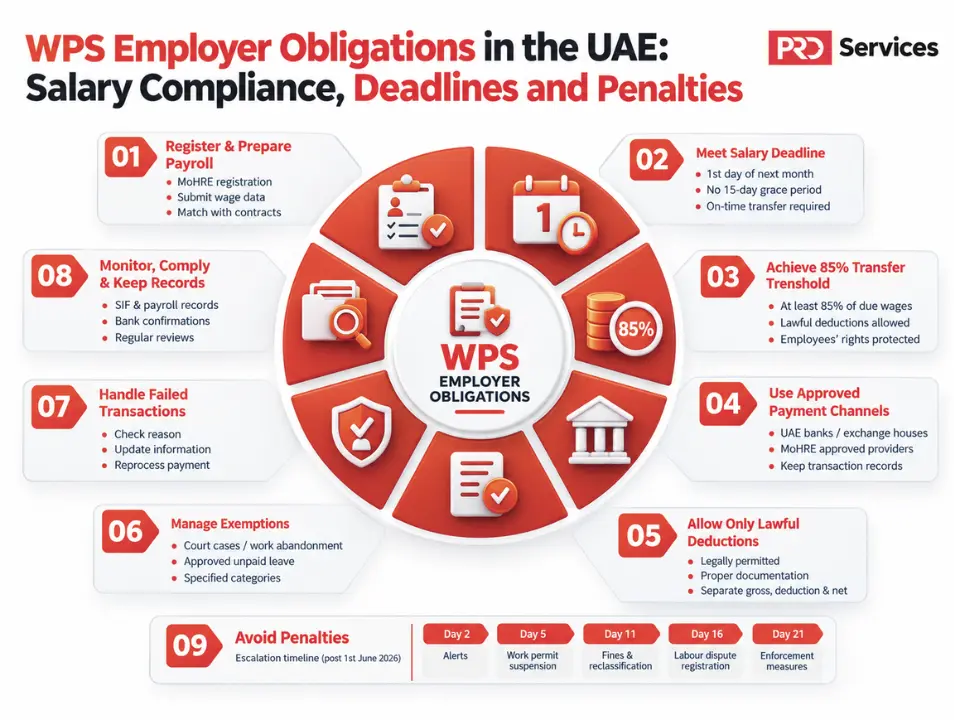
WPS employer obligations in the UAE required for registration and employer responsibilities
WPS employer obligations in the UAE start with proper payroll preparation.
- MoHRE registered establishments need to pay applicable wages through WPS or another MoHRE approved system.
- Employers must submit required wage data and payment information.
- Payroll should match employment contracts and MoHRE records.
Such controls create accurate salary file preparation as its next priority.
Salary file and employee data accuracy
Small payroll-data errors can appear as a WPS compliance problem.
- Verify employee identification and salary information.
- Check for bank account details before submission.
- Reconcile allowances and lawful deductions.
- Reviews Salary Information File (SIF) before processing.
Proper information minimizes rejected transactions and supports timely salary payments.
Current salary due-date rule under Ministerial Resolution No. 340 of 2026
The current due-date under WPS employer obligations in the UAE is very clear and stricter.
- Wages for the previous month are due on the first of the following Gregorian month.
- Any payment after that date is considered as delayed.
- The previous 15-day window under the earlier framework is no longer applicable.
This causes advanced payroll processing important for every payment cycle.
Current 85% transfer requirement under WPS employer obligations in the UAE
The 85% rule under WPS employer obligations in the UAE is a compliance threshold and not a permission to withdraw salary.
- One establishment is considered compliant when atleast 85% of the wages due are transferred by the due date.
- The applicable threshold can be achieved even if the unpaid balance results from lawful deduction.
- Employees retain their entitlement to lawful wages.
Therefore, deductions must always have proper legal support.
Authorized banks/exchange houses/financial institutions
The payment channel matters as much as the payment date.
- WPS employer obligations in the UAE operate via approved financial institutions.
- Eligible payment service providers, exchange houses and UAE banks can participate subject to Central Bank of the UAE approval.
- Employers need to retain transaction confirmations.
The correct payment channel support in maintaining an auditable payroll trail.
Lawful deductions based on WPS employer obligations in the UAE
An 85% threshold must never be treated as one automatic deduction allowance.
- Deductions must be legally permitted and properly documented.
- Payroll records must distinguish gross wages, deductions and net payment.
- Supporting records need to be retained for potential MoHRE review.
Proper documentation can help in resolving employee salary disputes.
Employee and employer exemptions under WPS employer obligations in the UAE
Certain categories are particularly excluded from WPS compliance.
- Employees with qualifying wage complaints referred to court.
- Workers reported for work abandonment.
- Employees on approved unpaid leave with supporting documents.
- Certain seafarers, foreign workers paid outside the UAE and mission permit workers.
- Specified employers comprising UAE National-fishing-boat owners, house of worship bank or financial situations and public taxi owners.
Late payment control remains consistent even if there is no exemption.
Failed transactions and corrective actions
A failed WPS transaction need immediate investigation.
- Rejection reason identification.
- Correct employee or banking information.
- Payment reprocess through approved channel.
- Successful transaction confirmation.
- Reconcile the correct payment with payroll records.
Quick correction can prevent a routine error from becoming a compliance issue.
Salary complaints through MoHRE
Employees must seek the formal route in case of delayed or unpaid wages.
- Workers can contact MoHRE.
- Salary complaints can be registered through the official channels.
- Employees must retain WPS and payroll evidence for supporting response.
This signifies systematic record keeping as an essential employer responsibility.
Compliance monitoring and records
WPS must be monitored every consecutive month and not only after a complaint.
- Keep SIF files, payroll records and payment confirmations.
- Reconcile bank or WPS reports against payroll.
- Exemptions, document deductions and corrected transactions.
- Review employee data prior to every salary cycle.
Businesses must review corporate services regarding financial compliance support.
Penalties and restrictions for non-compliance
As per Resolution No. 340 of 2026, there is a quick escalation process that has been enlisted regarding WPS employer obligations in the UAE.
| Timeline | Possible action |
| Day 2 | Notifications and alerts |
| Day 5 | New work-permit suspension |
| Day 11 | Administrative fine and Third Category reclassification for repeated violations within six months. |
| Day 16 | Labour dispute registration and further restrictions for specified cases. |
| Day 21 | Enforcement measures for qualifying cases. |
The specified measure rely on establishment and violation circumstances.
Entity coverage: MoHRE, WPS, UAE Labour Law, approved financial institutions
WPS compliance involves a connected regulatory system.
- MoHRE: employment regulation and WPS monitoring.
- UAEWPS: Electronic wage-payment mechanism operated within UAE payment infrastructure.
- Federal Decree Law No. 33 of 2021: Principal UAE private sector labour framework.
- Central Bank of the UAE: WPS payment infrastructure and participating financial institutions.
Regarding formal guidance, employers must check UAE Government salary-payment guidance.
Conclusion
The WPS employer obligation in UAE has emerged as most sensitive in 2026, specifically in the post first-day salary deadline and 85% compliance threshold. It has become necessary for employers to update payroll procedures, verify WPS data and carry complete payment record maintenance. Are you looking for professional support regarding UAE payroll compliance? Connect with ProServicesDubai for professional guidance.
Frequently Asked Questions (FAQs)
If a bank causes a WPS salary delay can the employer still be penalized?
Definitely, a bank related delay does not target any employer in case of WPS liability so it’s necessary for the employer to document the bank error and notify MoHRE promptly.
Does the new 2026 WPS rule apply to salaries that were already overdue before 1st June 2026?
The new WPS rule applies from June 1, 2026, while previously unpaid salaries remain an outstanding wage obligation that the employer must settle.
Can an employer mark an employee as “excluded” in WPS in order to avoid paying the salary?
Definitely not, an exclusion must fall within one recognised WPS exemption and cannot legitimately be used simply in order to avoid salary payment obligation.
Is it permitted for any employee to change their job if the employer does not pay WPS salaries?
Potentially yes, but the employee’s right to transfer without normal notice of compensation depends on the circumstances and applicable MoHRE procedure.
Does WPS track salary payments that are consistently made late every month?
Definitely, WPS monitors wage payment compliance and repeated late payment leads to warnings and progressively stronger measures under the 2026 framework.



No comment yet, add your voice below!