
A single unreported transaction could cost your business heavily. With rising regulatory scrutiny, UAE AML compliance SMEs are now mandatory.
Small and medium businesses must understand reporting duties and handle suspicious transactions carefully in order to avoid fines, potential legal consequences and reputational damage in 2026.
Regulatory enforcement across UAE sectors has significantly increased, making proactive compliance essential rather than reactive.
Understanding UAE AML compliance SMEs
UAE AML compliance requires businesses to adhere to strict regulations in order to prevent financial crimes. Small and medium enterprises must implement proper customer verification, reporting systems and transaction monitoring.
Regulatory authorities expect businesses to actively detect and report improper or suspicious activities. Understanding these requirements is essential to avoid penalties and ensure compliance with UAE regulations.
UAE AML compliance is administered by Federal Decree-Law No. 20 of 2018 and Cabinet Decision No. 10 of 2019. It establishes the legal framework for AML and counter-terrorism financing obligations.
Businesses should also be aware of UAE compliance penalties 2026, which outline the financial consequences of non-compliance.
Reporting duties under AML regulations
Ignoring suspicious transactions is a significant compliance risk in the UAE. Under UAE AML compliance SMEs, businesses must actively report unusual activities to authorities. Failing to do so can lead to heavy penalties along with reputational damage.
Reporting is conducted via goAML system which is UAE’s official Financial Intelligence Unit (FIU) platform for suspicious transaction reporting.
| Duty Type | Requirement |
| STR Filing | Mandatory |
| Record Keeping | Required |
| Customer Due Diligence | Essential |
| Monitoring | Continuous |
Note: Penalties for non-compliance ranges between AED 50,000 to AED 5 million based on the violation severity.
Handling suspicious transactions
Failure to identify and report suspicious activity can result in substantial penalties. Under UAE AML compliance SMEs, monitoring is important.
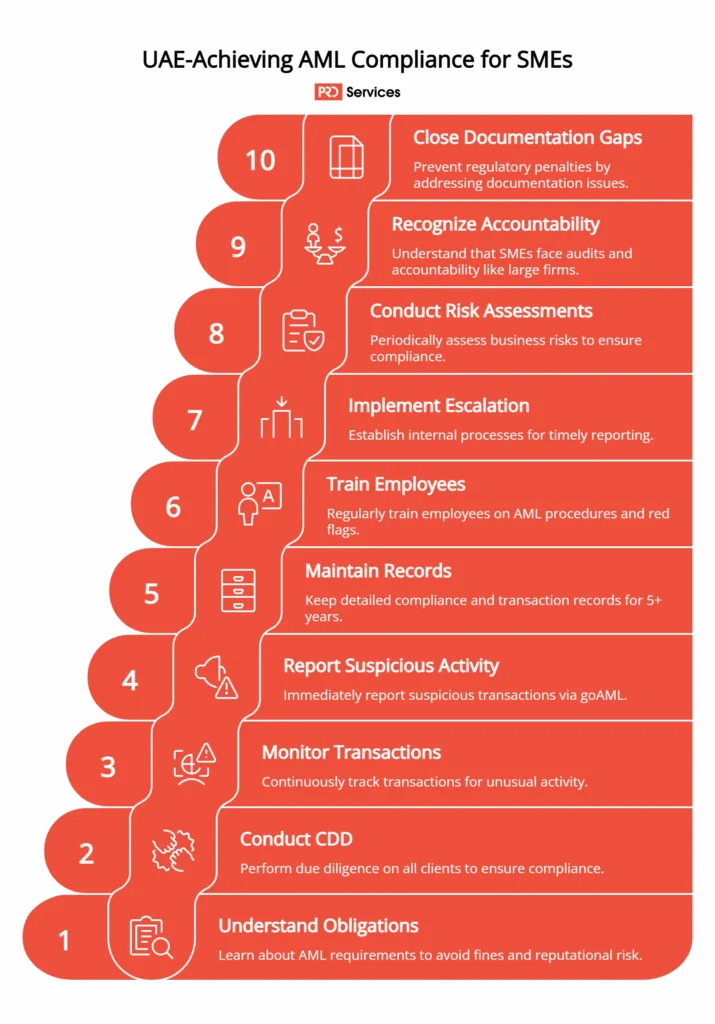
- Track unusual transactions.
- Report suspicious activity.
- Train employees.
- Maintain compliance records.
Example: A trading company accepts repeated payments just below reporting thresholds from distinct offshore accounts. This outline may specify structuring and need to be reported as a Suspicious Transaction Report through goAML.
PRO tips: Establishing internal escalation actions ensures timely reporting and minimises regulatory risk.
AML Compliance framework for SMEs
Without a proper system, compliance becomes a risk. Under UAE AML compliance SMEs, businesses must develop structured processes to monitor transactions, verify customers and report suspicious activity. A well-defined AML framework ensures regulatory compliance and reduces financial and legal exposure.
An inclusive framework should comprise risk assessment, ongoing monitoring, customer due diligence (CDD), periodic staff training and internal reporting mechanisms.
Compliance Reality: What Businesses Must Know
Regulators majorly rely upon AI monitoring systems that can automatically flag inconsistencies, causing minor documentation gaps high-risk triggers.
- Regulatory audits are growing in frequency
- SMEs are correspondingly accountable as large firms
- Non-compliance can lead to account suspension
- Documentation gaps are a common violation
Note: Understanding reality prepares you for long term success.
Businesses may also refer to Company liquidation in UAE 2026 for understanding exit compliance requirements.
Quick Compliance Checklist for SMEs
Here is a quick compliance checklist for SMEs.
- Address business risk assessment
- Apply Customer Due Diligence (CDD)
- Do registration on goAML system
- Maintain transaction records for atleast 5 years.
- Regular staff training.
- Report suspicious transactions immediately
Conclusion
AML compliance is a regulatory requirement and a business safeguard. Companies that integrate strong compliance systems successfully avoid penalties and build a longing trust with financial institutions and regulators. Adopting a proactive compliance approach helps in reducing risk and also enhances business credibility with banks, regulators, and stakeholders.
Connect with us for AML policy development, reporting support, and compliance training.
Frequently Asked Questions (FAQs)
What is AML compliance in UAE?
AML compliance refers to regulations designed to prevent money laundering and financial crimes in the UAE.
Who must follow AML rules?
All Designated Non-Financial Businesses and Professions (DNFBPs) and regulated entities must comply with AML regulations.
What is the suspicious transaction report?
A suspicious transaction report is a report filed when any unusual financial activity is detected.
What is goAML system?
UAE’s platform for reporting financial crimes is goAML system.
What happens if AML rules are ignored?
Non-compliance can lead to fines, account suspension, regulatory penalties, and potential business closure.

No comment yet, add your voice below!